
Documentation Index
Fetch the complete documentation index at: https://docs.morf.health/docs/llms.txt
Use this file to discover all available pages before exploring further.

Getting Started
With the Tiktok Events API integration, track events in workflows. Some configuration is required to use the Tiktok Events API integration to allow Morf automations to act on your Tiktok Data Sources.- Go to Events Manager.
- Then go to “Data Sources” and select the data source you’d like to send events to.
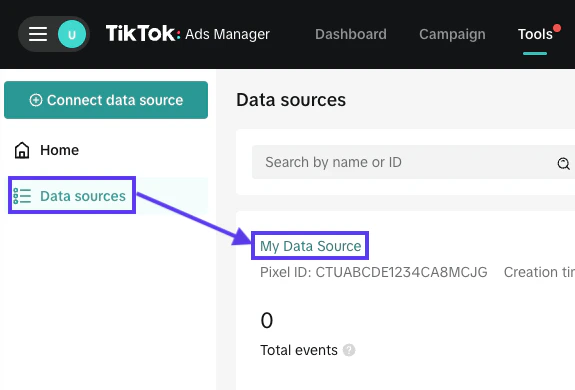
- Click on the “Settings” tab and scroll down to the “Access Token Generation” section, then click on “Generate Access Token”: we are going to use the token in Morf.

- Now go to the “Test Events” tab and copy the “Test Event Code” (e.g.
TEST12345), we are going to use it to verify our integration. We are also going to need the “Data Source ID” which is available on the same page.
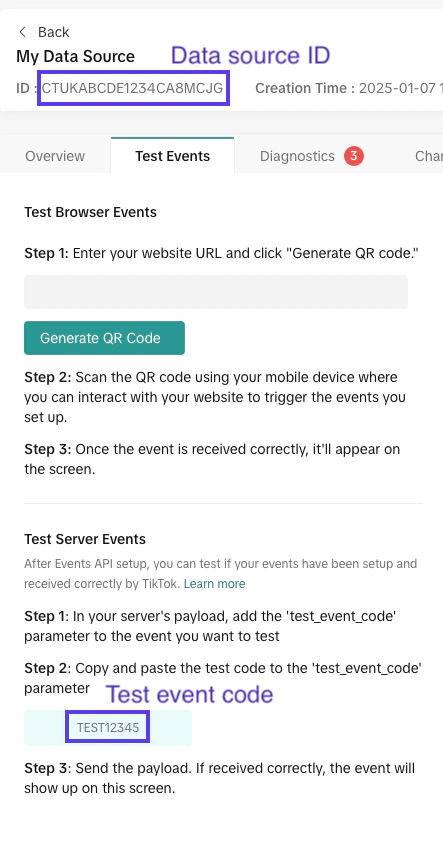
- Add a new Integration.
- Select Tiktok Events Access Token.
- Paste your Data Source ID as “Pixel ID”, and the token generated earlier in “Access Token”.
- In a Workflow, add a “Send Event” action, and populate the “Test Event Code” field with the code from above (format:
TEST12345). - If the integration was successfully set up, events should appear in the “Test events” tab of your Tiktok Data Source.
- Remove the “Test Event Code” value from your action.
Parameters
Result Object Field Details
You can use the result of the action’s data as inputs to downstream workflow actions. Each fetch action requires a result object key to be specified which will nest the action’s result data inside the downstream data context in the Workflow. Here we demonstrate how to refer to this data using the prefix$result_object_key.